One weekend, 11 programs: what lacrosse coaching sounds like at the IWLCA President's Cup
sessions
14
programs
11
minutes of coaching
408
words analyzed
28,191
The short version: Over two days at the IWLCA President's Cup, coaches from 11 college and club programs wore a C2X mic on the sideline. They recorded games, halftime talks and warm-ups: 408 minutes and 596 coaching moments in total. Game-day lacrosse coaching turned out to be mostly tactical, mostly delivered while the ball was live, and quieter than you'd expect: coaches were silent for more than half of the recorded time.
What we measured
On November 20–21, 2026, coaches from 11 programs used C2X at the IWLCA President's Cup. They recorded 14 sessions: full games, single halves, halftime talks, a goalie warm-up and team warm-ups. That came to 408 minutes and 28,191 words of coaching. Every session was measured on the same coaching behaviours as the rest of our data. For 11 sessions, our lacrosse sport pack also sorted every coaching moment into tactical or technical and tagged the part of the game it was about.
Every C2X measure is grounded in coaching research: 45 years of coaching, 6 PhDs, and a research project with Manchester Metropolitan University.
What we found
55%silent time
223 min silent184 min talking
Coaches listened more than they talked.
Coaches were silent for 55% of the recorded time (223 minutes of silence against 184 minutes of talk). Game day isn't non-stop shouting. Listening and observing took up more of this weekend than talking.
66%Tactical34%Technical
11 scored sessions
38 / 39goalie warm-up moments were technical
Game day is tactical.
In the 11 sessions our lacrosse pack scored, 66% of coaching moments were tactical (where to be, when to slide, how to attack) and 34% were technical (how to catch, cradle or check). The goalie warm-up flipped that: 38 of its 39 coaching moments were technical. The same coach sounds completely different depending on the job in front of them.
~4 in 10settled defense / offense
Transition 17%Draws 5%Man-up / down <1%
Settled play gets the attention.
Nearly 4 in 10 coaching moments were about settled defense or settled offense, and transition got another 17%. Draws (5%) and man-up/man-down (under 1%) got far less airtime.
Instruction while the ball is live
Lacrosse72%
Soccer71%
Different sports. Similar timing.
Most teaching happens mid-play.
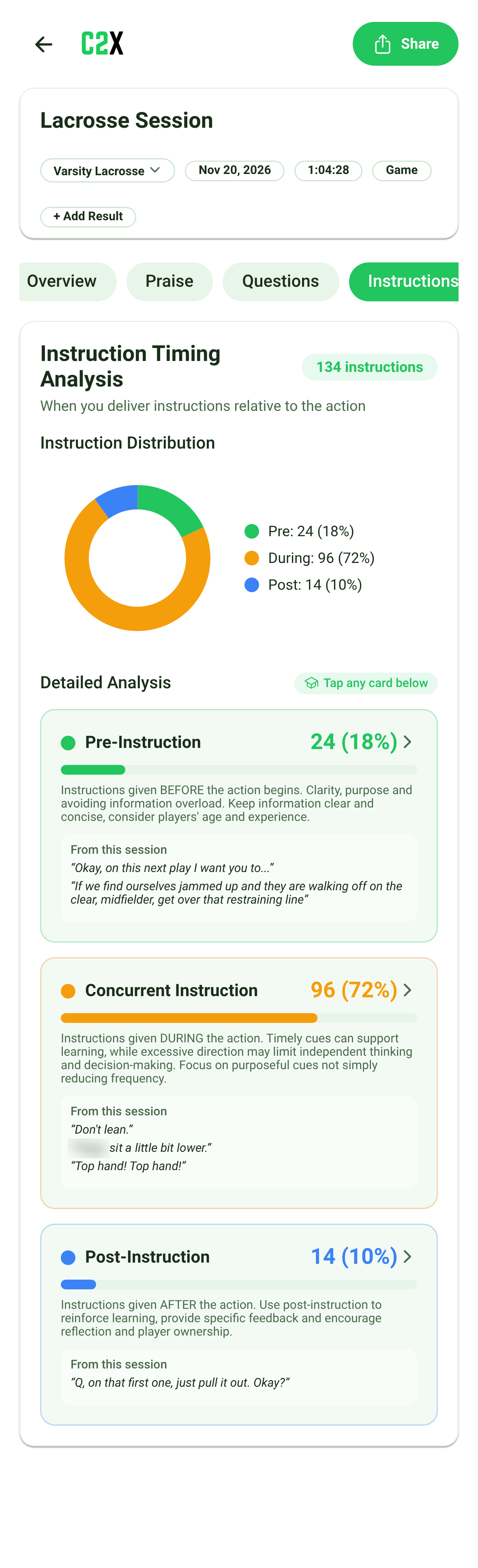
72% of instructions came while the ball was live. C2X uses under 15% as a starting guide, not a universal standard. That's almost exactly what we see in soccer games (71%), so it's a coaching habit, not a sport difference. Only 12% of instructions came after the action, the moment when players have the experience fresh and can reflect on it.
12%of questions were open-ended
394 questions · 1 follow-upObserved this weekend · Not a recommended target
Lots of questions, few open ones.
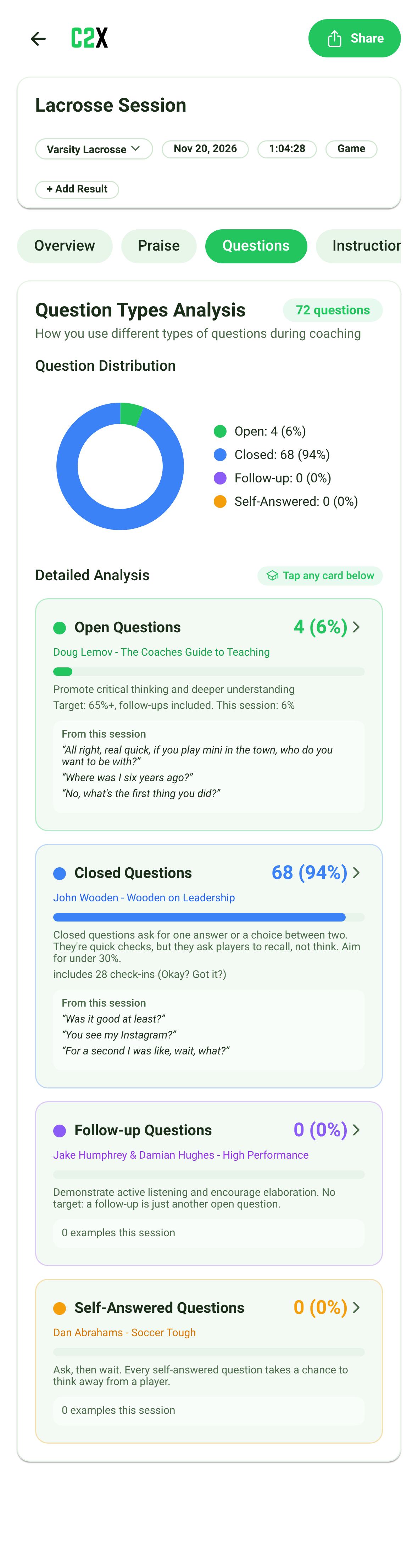
Coaches asked 394 questions. Only 12% were open-ended, and only one was a follow-up. C2X suggests 65%+ open questions as a starting point for reflection, not a research-established standard every session should meet. The useful question is whether players had enough opportunities to explain what they saw and why they made a decision.
59%player-centered communication
Communication leaned player-centered.
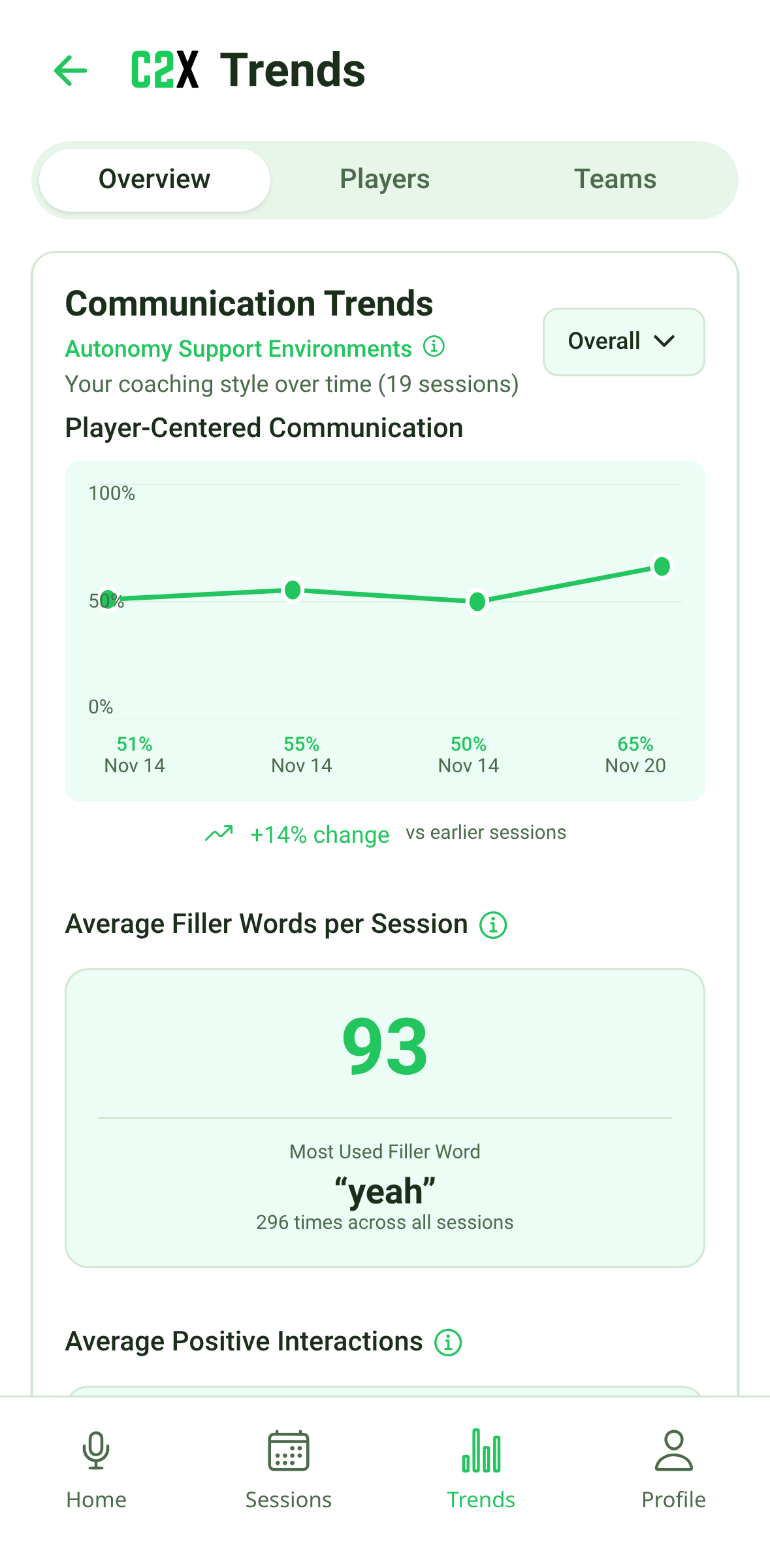
59% of communication was player-centered, close to C2X's suggested starting guide of 60%. The purpose is to create room for player choices and input, not simply to hit a percentage.
16 playersnamed per session, on average
45% of feedback aimed at an individual
Coaches know their players.
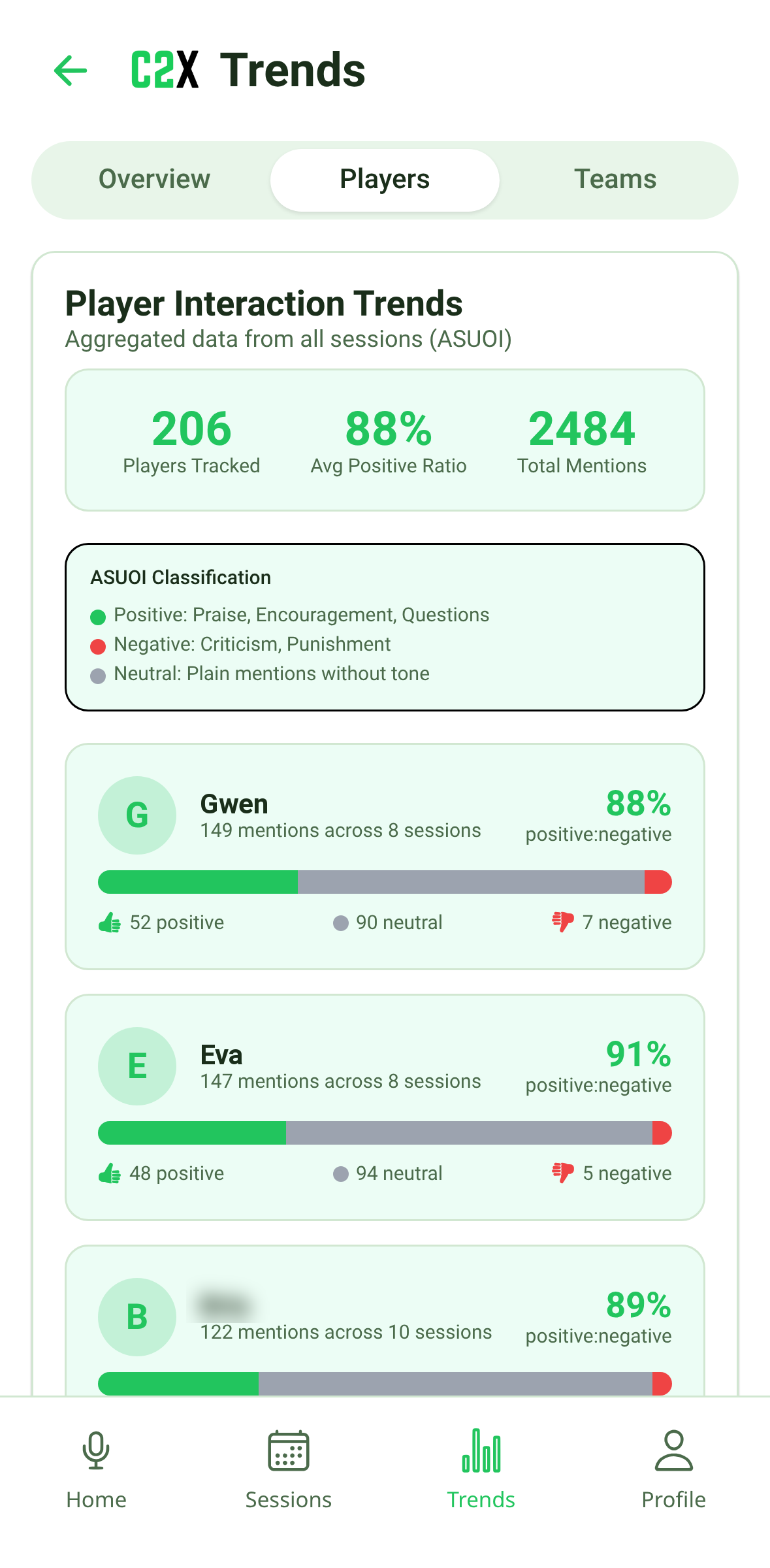
On average, coaches called 16 different players by name in each session, and 45% of feedback was aimed at an individual player.
Four sideline modes
We plotted all 14 sessions on two questions: how much of the time was the coach talking, and how much of their feedback went to one player rather than the group. Every one of the four corners was used.
The Reader
Quiet, speaks to the group. 5 of 14 sessions.
Works when: Players know the plan and need room to play.
Watch for: Players may not know feedback is meant for them.
The Spotter
Quiet, then one targeted word to one player. 3 of 14.
Works when: One player's decision is the difference.
Watch for: The rest of the group may hear very little.
The Connector
Vocal and personal. 3 of 14.
Works when: Building confidence and relationships, like warm-ups and young teams.
Watch for: Talk load. Players also need space to think.
The Conductor
Vocal, to the whole group. 3 of 14.
Works when: Halftime, warm-ups and set-ups.
Watch for: Information flowing only one way, from coach to player.
Modes, not personalities. Every coach who recorded more than one session landed in a different corner each time, depending on the job in front of them.
14 sessions from one tournament weekend. A snapshot, not a study.
Individual feedback ran from 0% in a halftime team talk to 76% in a single half of play. One coach asked no open questions in a half, and another asked seven. That spread is the point: a tournament average tells you about lacrosse, but each coach's own numbers tell them what to work on.
What this could mean for the game
These 14 sessions capture real coaching across women's lacrosse games, halftime talks and warm-ups. Tracking the same behaviours across programs can give coach education a clearer link to what happens on the sideline.
A coaching benchmark for women's lacrosse
Measure the same behaviours across every division, so coaches can compare themselves to the game, not just to their own memory.
Convention and clinic content from real sidelines
Build coach education around what actually happens on game day, not what coaches think happens.
Coach education you can see
Check whether the habits taught in clinics and certifications show up in the next game.
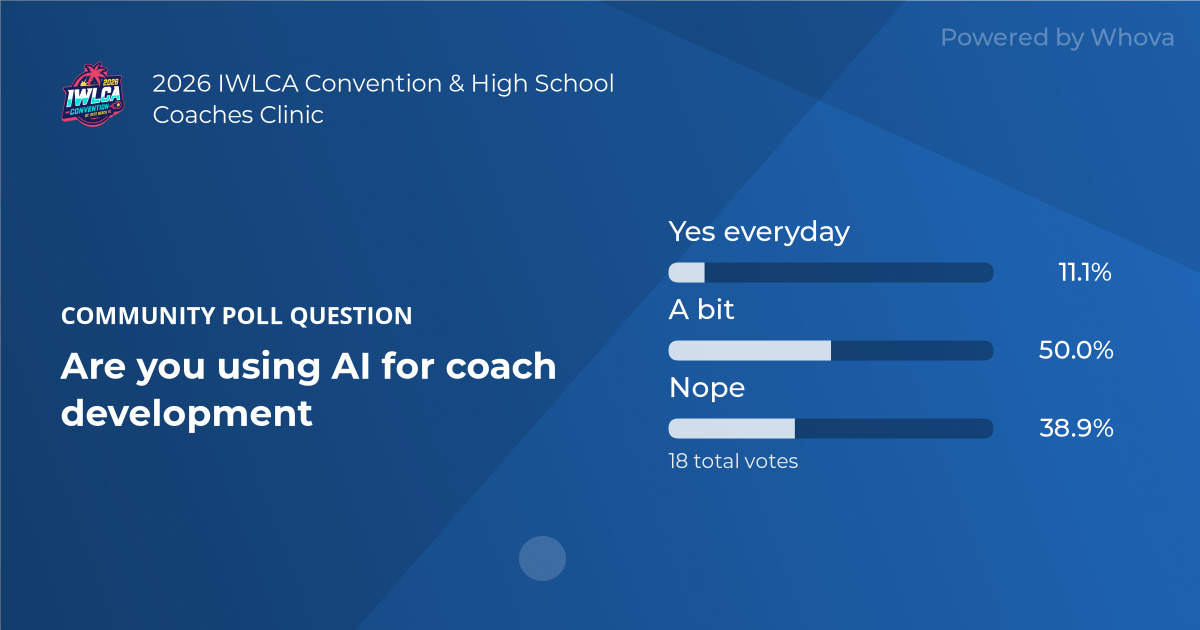
At the 2026 IWLCA Convention & High School Coaches Clinic, we asked coaches a community poll question: are you using AI for coach development?
Community poll, 2026 IWLCA Convention & High School Coaches Clinic · 18 votes
89% of coaches polled at the IWLCA conference are not yet using AI to help their own coach development. The appetite for better feedback is there; the tools just haven't reached the sideline yet. That's the gap C2X is built to close.
Why it matters
How a coach communicates shapes more than the next possession. Players need to feel heard, understand feedback and have room to make decisions. Clear, personal feedback and genuine questions can help build trust between players and coaches, creating a better environment for learning, confidence and enjoyment.
Those relationships matter beyond the field. When players feel supported and understand their role, conversations between parents and coaches have a stronger foundation. For programs, a positive playing environment can support player retention; a culture that helps coaches reflect and develop, rather than simply judging results, can support coach retention too.
This weekend did not measure retention or relationship quality. It measured 596 coaching moments that programs can use to start more useful conversations: who gets feedback, whose voice is heard, and whether coaching gives players space to learn. Better coaching environments are the goal; the numbers are a starting point, not the outcome.
What C2X does about it
After every session, C2X shows the coach their own numbers: open vs. closed questions, when instruction happens, how feedback lands and, for lacrosse, the split between tactical and technical coaching. Directors see the same picture across their whole staff, from game day to warm-ups. For associations, we report the same measures in aggregate and de-identified, like this page, so no individual coach is singled out.
See it in the app
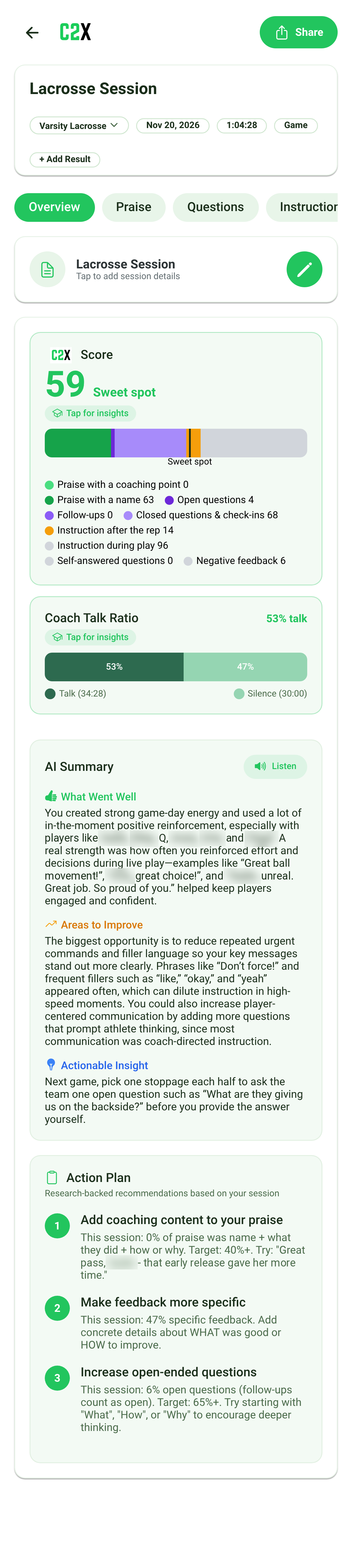
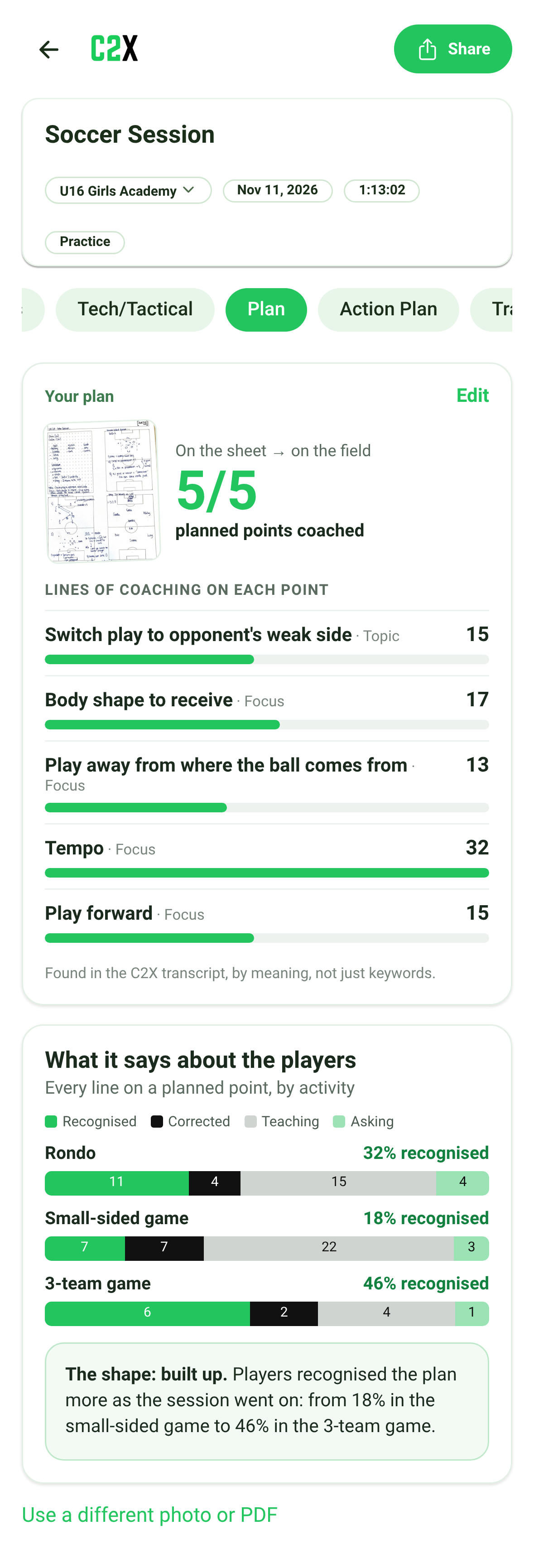
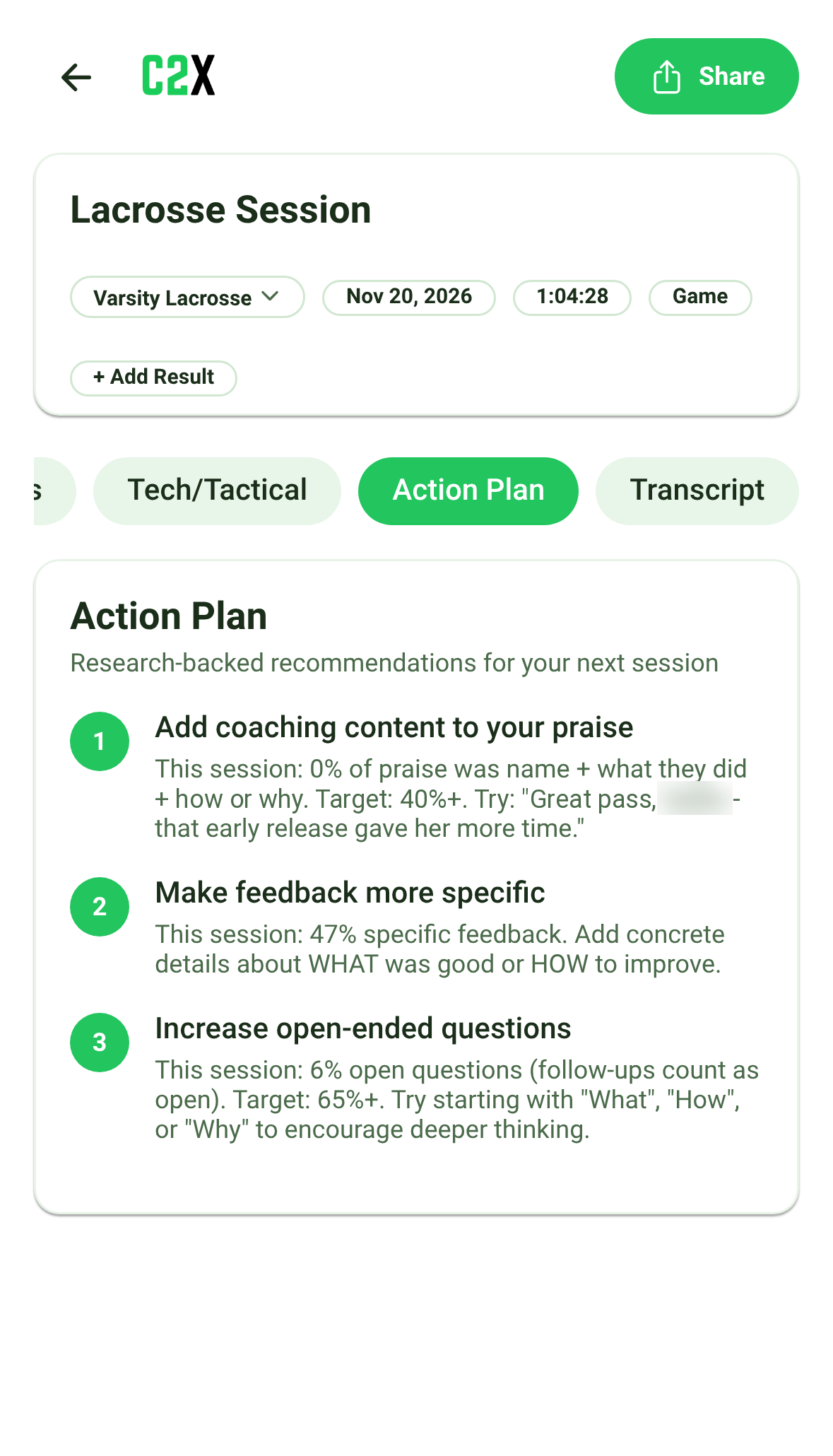
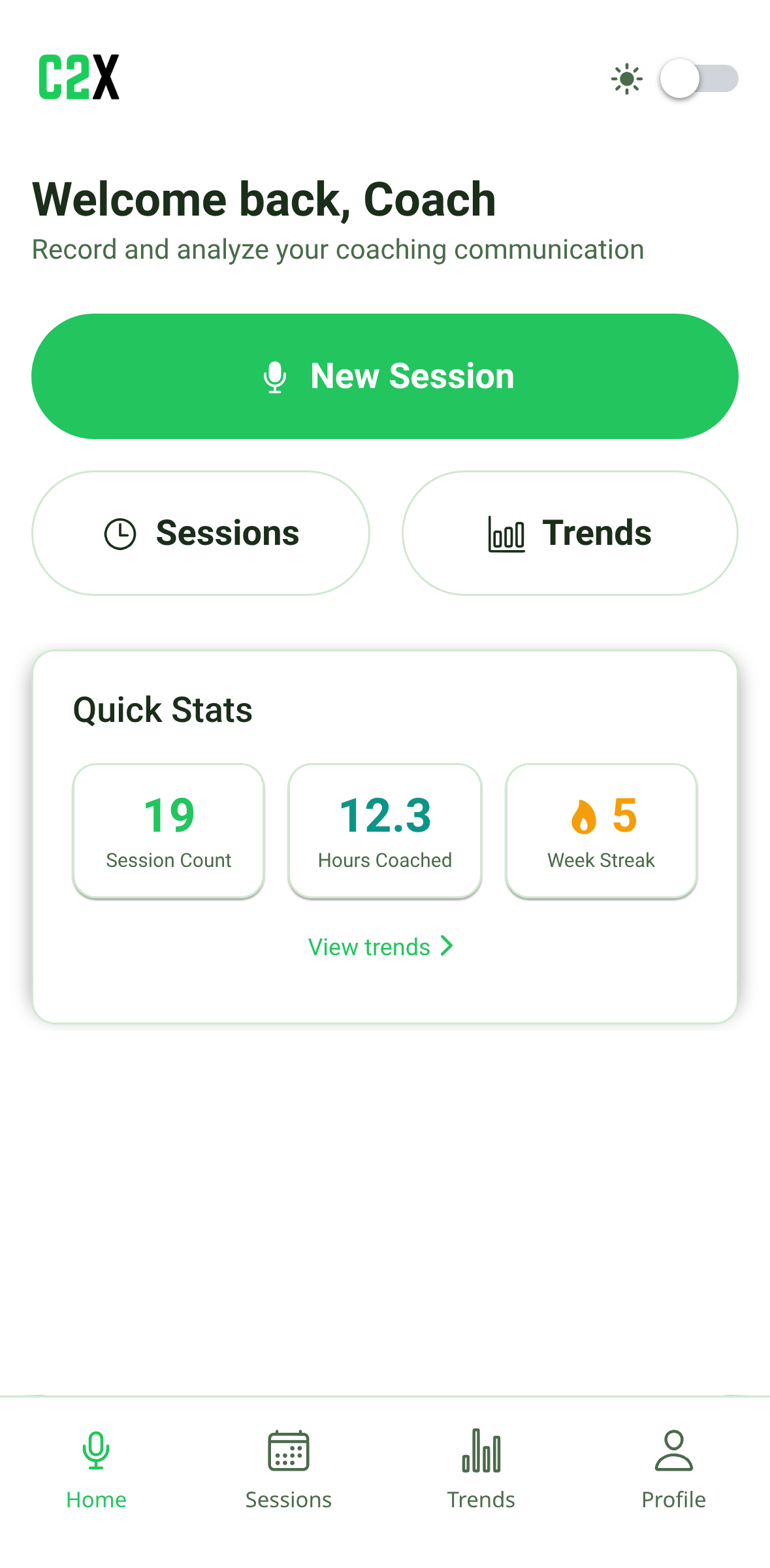
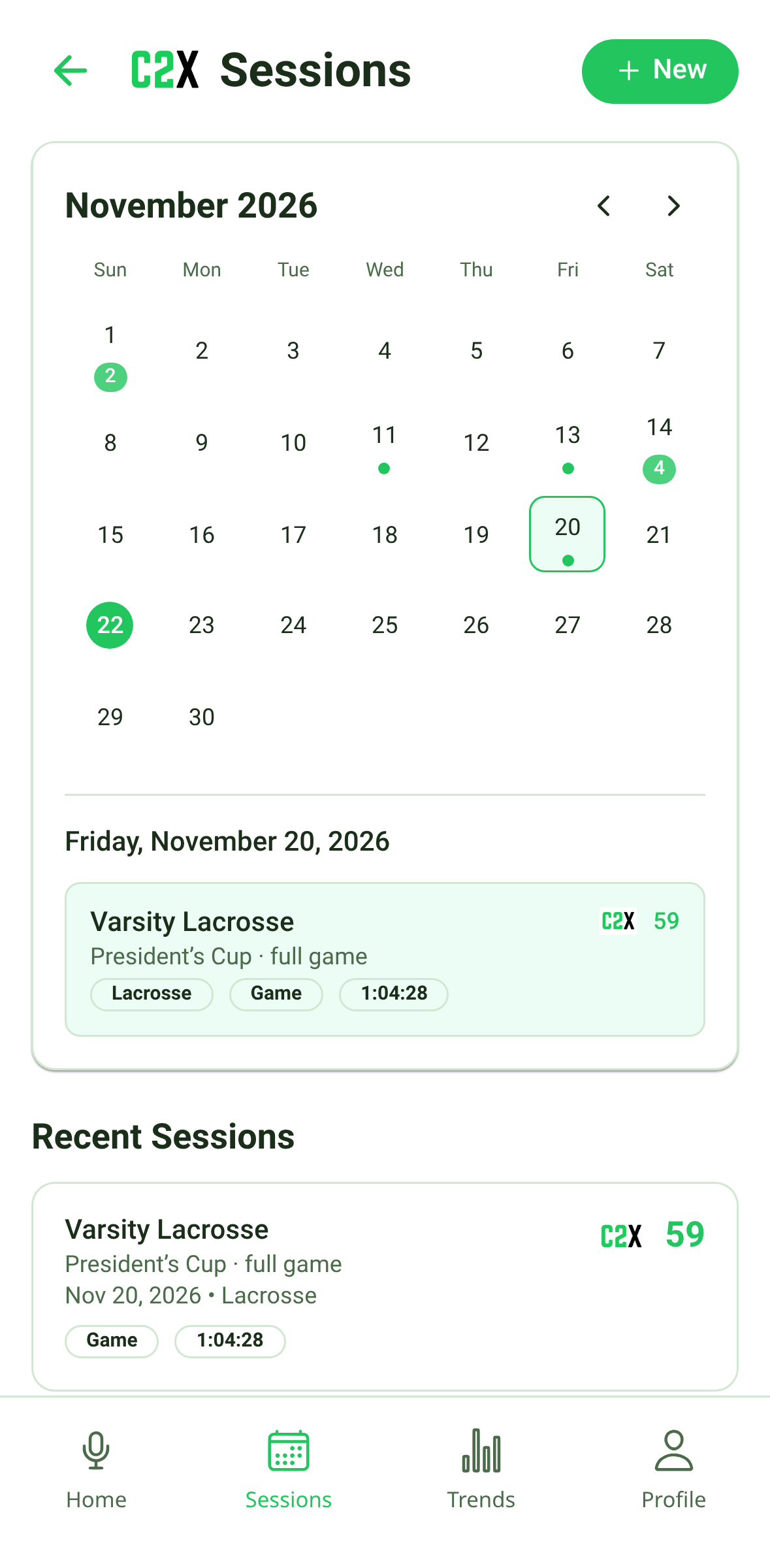
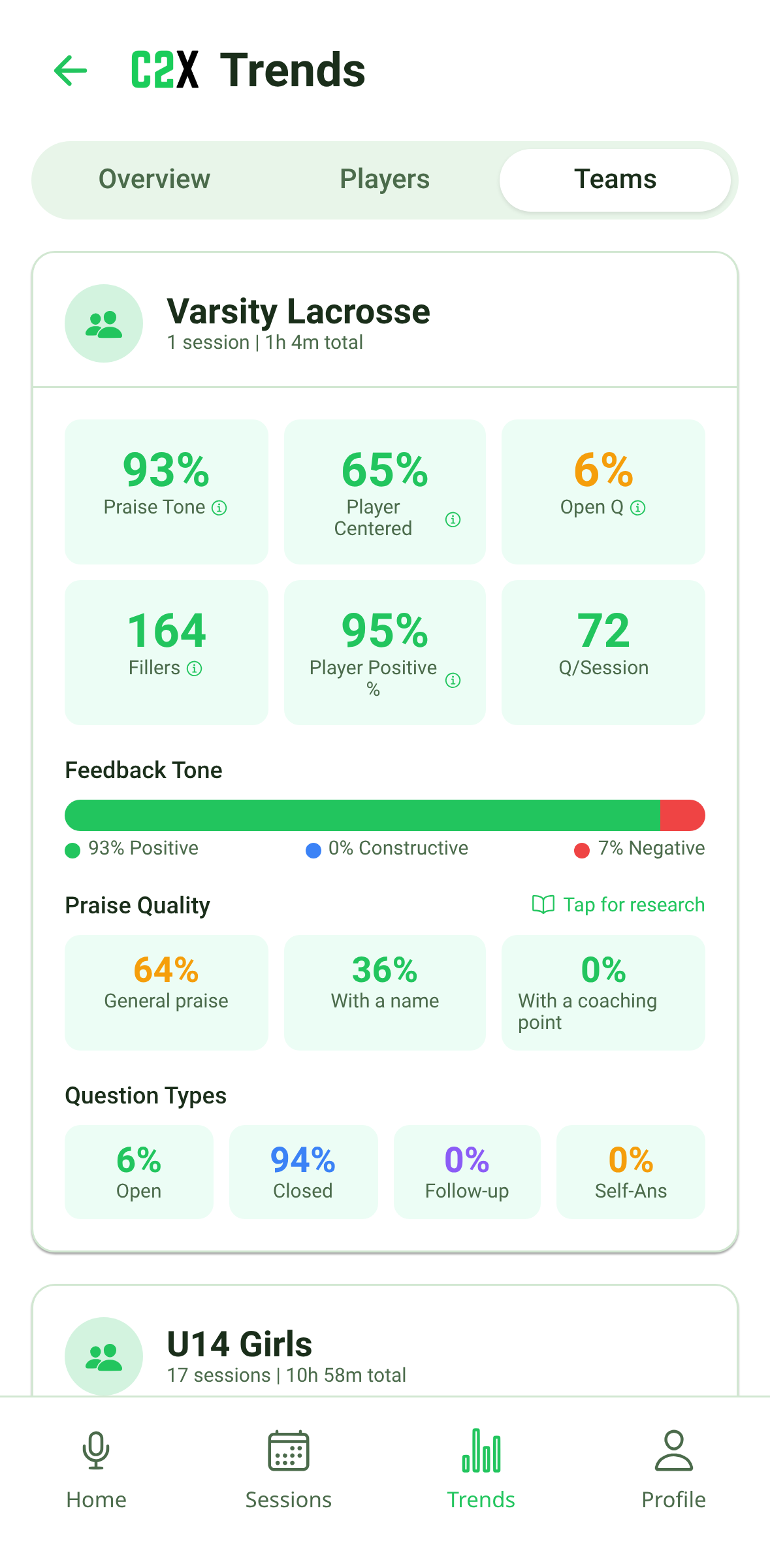
This is the report a coach opens after a session like the ones recorded this weekend. Tap through the real screens below: the session report, the calendar, trends over time and the rest of the app.
Inside a session
Around the app
Scroll inside the phone to see the full screen.
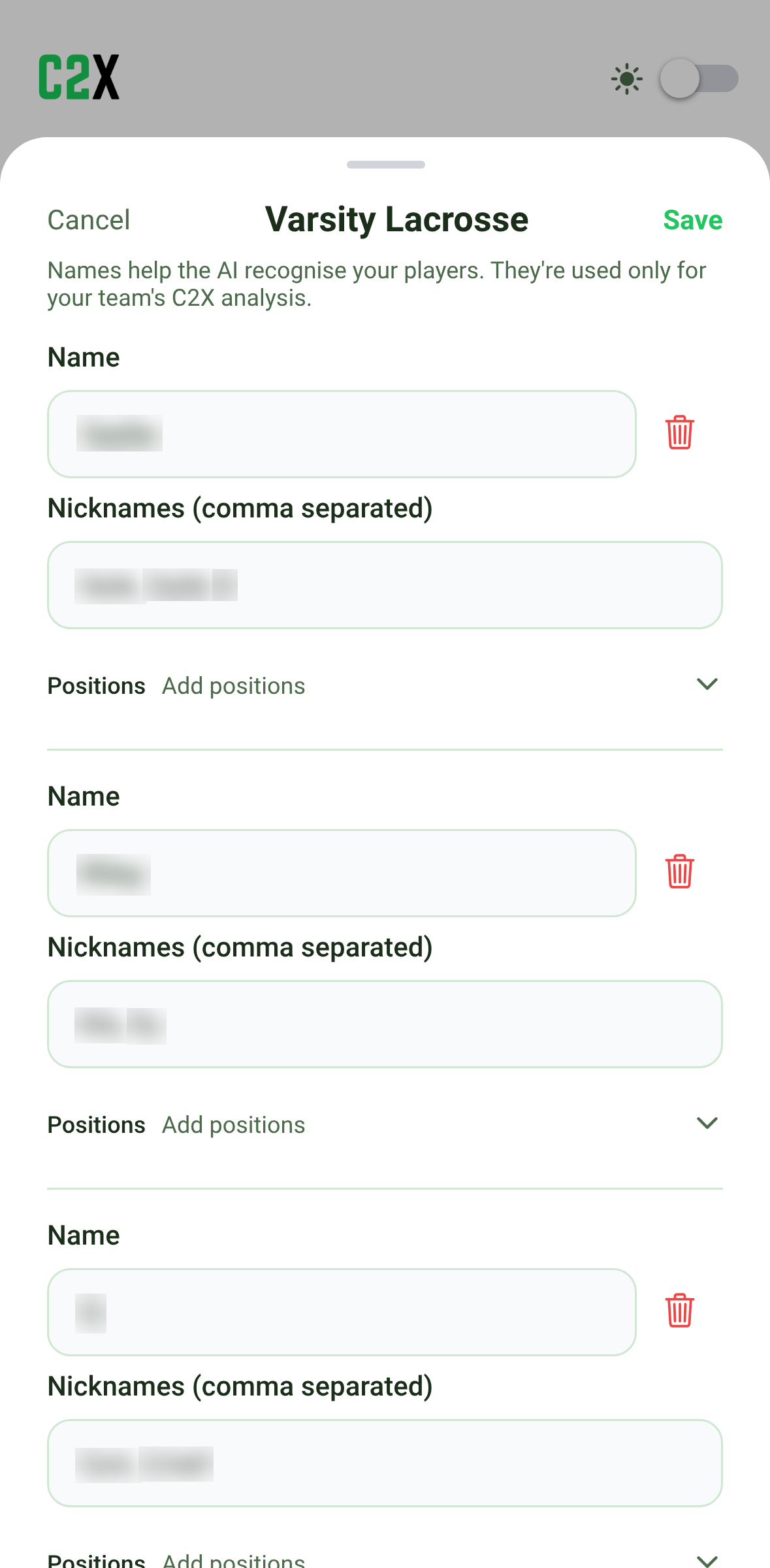
Real screens from the C2X app. Player names blurred.
01 · Overview & C2X Score
ONE NUMBER TO STRIVE FOR
The C2X Score (59, in the 55+ sweet spot) measures how much of the coaching gave players ownership: counts toward ÷ (counts toward + counts against), on a 0–100 scale. Below it: Coach Talk Ratio (34:28 talk, 30:00 silence; awareness only, because silence can be intentional coaching) and a written summary with one thing to try next time.